BlogThe AI Operating System
What an AI Operating System actually is
Every data layer of a company joined into one brain you can talk to. Why that is a framework rather than software, and the hiring run that shows it working.
An AI Operating System brings your company’s knowledge and tools together so your team can ask questions and hand over manual work. Imperium builds and runs that foundation. ARX is how each person uses it on their desktop. We install these systems for a living at Imperium, and we have explained the idea on stage enough times that it deserves a written home. Everything below is what Archie and I actually say in the room, sourced from the talks themselves.
What do we actually mean by an AI Operating System?
The cleanest version I have said on stage is this one, from our one-hour mastermind on the subject:
"Imagine taking, instead of the knowledge of just one person, the knowledge of an entire business, and condensing that into one thing. One operating system which you can speak to, to allow you to have the very best decisions for your company, and execute faster than anyone else."
Alex, What is an AI Operating System?, Imperium mastermind
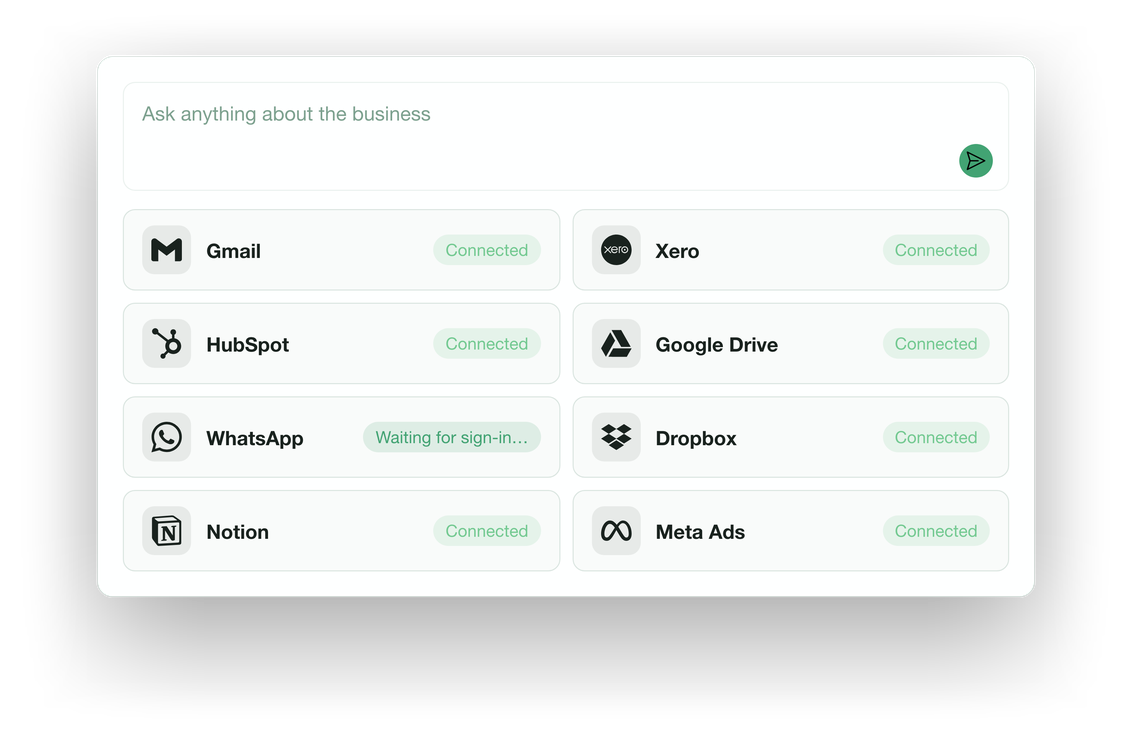
Archie's version, explaining it to a nine-figure operator on his channel, is even plainer: "we're combining every single data layer of your company, whether it's your CRM, whether it's your WhatsApp business, your emails, everything, into one centralised hub."
A business of 20 to 250 people usually runs on dozens of separate tools. The owner checks the CRM, then the ad manager, then the group chat, then the accounts, and rebuilds the picture of the company in their head every single morning. The AI Operating System inverts that. As we put it at the mastermind, imagine operating 40 platforms in one place, with the system only telling you what is most relevant, so you can cut the noise and focus on the signal. The clip below is the whiteboard version of this section: the hub drawn live, the room calling out its own data sources, and the morning the system gives back.
Why is it a framework and not a software product?
Because we have watched software die too quickly to sell you any. We spent around 50 thousand dollars building our own product, and better AI models made it redundant within months. I said so on the record: "we spent our 50k building our own stuff. With the new Claude models coming out, it kind of just already eradicated itself. So the advantage is being faster moving than everyone else."
That experience shaped the architecture. The AI Operating System is a set of files on your own computers: context documents that describe your business, skill files that hold your best thinking, and connectors that pull data from the tools you already use. The model that reads those files is swappable. At the revenue mastermind I explained it directly: "because all of these files are locally on your computer, it doesn't matter if you're using Claude, Codex, whatever other model. You can just switch the model out." The fuller answer, given when the room asked whether it all runs on Claude, is below: the files are the foundation, the model is a part you swap, and automating first puts you in a loop of rebuilding every time a new tool appears.
The figure below is that picture.
This is also why I keep saying the strange-sounding line about software. At the founders' mastermind I put it this way: "I don't really think software companies will exist. They'll be like data companies, and you just plug into like a cloud and you process that data." The interface layer of most software is now trivial to rebuild. The data underneath it is the only part that holds value.
What does it look like on a normal working day?
The story we tell most often, because it happened exactly this way, is the hiring run. We needed video editors. At 9:00 in the morning I gave the system one instruction, then went to the gym. It created an account on a hiring platform, posted the listing, contacted around 300 candidates, read portfolios, built the shortlist spreadsheet, and booked the interested ones into a Google Meet for 5:00 that afternoon. Archie and I got on the call with 25 video editors. By the end of the next day we had hired two, full time.
"I sent off the prompt in the morning at 9:00 a.m. Went off, went to the gym, didn't touch that system for the rest of the day. At 5:00 p.m., we had 25 video editors on that call."
Alex, told at the mastermind and again in the real estate masterclass
The principle behind the story is the one that matters: whatever can be done on a screen can be done through an AI Operating System. Hiring happened to be that day's example. The same system writes the follow-ups, reconciles the reports, watches the ad accounts, and briefs the owner every morning. The telling below has the system's own record of the run open on screen, and ends on why the principle holds: code is what everything on a screen is built from, so a system that can write code can operate the screen.
Where do most businesses get this wrong?
They start at the wrong end. There is a four-step sequence we quote in almost every talk, borrowed from Elon Musk's engineering algorithm: question the requirements, delete what is unnecessary, simplify what remains, and only then automate. Automation is deliberately last. As Archie asked the room, what is the point of automating something if it doesn't need to be in your company?
Most AI projects begin at step four. A team buys a tool, automates a process nobody questioned, and wonders why nothing changed. Building the AI Operating System starts at the bottom instead, with data. At the mastermind I called it the foundation: every company is sitting on more data than it has ever used, and if that data is organised properly it becomes the base the whole system stands on. The exchange below is where that came up: Archie asks why you should not just build the WhatsApp agent today, and the four steps on the pyramid are the answer.
Does the system replace your judgement?
No, and we are blunt about this in the room. You understand your business better than anyone else, which means you know what good looks like, and the system does not until you teach it. The onboarding advice we give owners is deliberately unglamorous: treat it like a normal employee. Train it on step one, check the work, then hand over step two.
The human stays the moat. The line I use on stage is that AI can't be Archie better than Archie, and the clip below is the moment it came out.
Nobody can be you better than you, because the system has none of your lived experience. What it removes is everything around your judgement: the rebuilding of context, the chasing, the retyping, the reporting. What it cannot replace is the judgement itself.
If you want the full argument in our own voices, the one-hour mastermind recording is public, and the two-hour session is the raw version with founders in the room. This article is the written spine of both.